What is osteochondritis dissecans of the elbow?
Osteochondritis dissecans (OCD) of the elbow is a condition that can affect young athletes who participate in sports that require repeated overhead motion – like gymnastics, baseball, softball, tennis and weightlifting. When the elbow joint undergoes repetitive stress during activities, it can result in injury to the bones and overlying cartilage in the elbow joint.
If left untreated, these regions of weak bone can cause significant pain, limit activity, and may become unstable as the cartilage and underlying bone may break off and become loose bodies floating in the elbow.
Here is some information to help you understand OCD of the elbow. The elbow joint is made up of three bones – the upper arm (humerus bone) and forearm (ulna and radius bones). At the bottom of the upper arm bone (humerus) there are two smooth surfaces – one on the inside of the elbow (trochlea) and one on the outside (capitellum). Osteochondritis dissecans of the elbow most commonly affects the outside of the elbow, or capitellum, and due to repetitive stress or impact loading may cause a part of the cartilage in this region to soften, crack or separate from the bone. This area is more commonly predisposed to this condition due to underlying blood flow in the area. Damage to the cartilage and bone causes pain and may restrict range of motion.
OCD of the elbow is a rare condition that can affect boys and girls at any age but is more often diagnosed in boys aged 8 to 19.
While OCD of the elbow can resolve without treatment in some pediatric and adolescent athletes, in most cases intervention is needed. An evaluation by a skilled pediatric orthopedic or sports medicine physician is recommended to ensure the bones and cartilage in the elbow do not become unstable and lead to diminished elbow function and arthritis.
Because OCD of the elbow is an injury that strictly affects youth, pediatric specialists are recommended over adult providers. Pediatric sports physicians have the experience, training and expertise to treat OCD of the elbow.
Osteochondritis dissecans can also affect the bones in the knee, hip and ankle.
Causes and risk factors of OCD of the elbow
While the exact cause of OCD is still unknown, there are many factors that may contribute to a temporary, compromised blood supply to the elbow in a growing and active youth, including:
- Overuse or repetitive impact to the joint
- Involvement in high-impact sports
- Repetitive stress of the elbow joint, in sports like baseball, gymnastics, tennis and weightlifting
- Specialization in one sport such as baseball or gymnastics from an early age
- Year-round sports training that requires repetitive elbow movement
- Personal or family history of OCD
- Prior injury or trauma to the elbow
Signs and symptoms of osteochondritis dissecans of the elbow
The most common symptom of OCD of the elbow is pain, which typically occurs on the outside and back of the elbow and tends to worsen after certain activities like throwing, weight-lifting and strenuous arm movement.
Other symptoms may include:
- Swelling of the elbow and arm
- Popping, clicking, catching or locking at the elbow joint
- Stiffness in the elbow joint and/or arm
- Decreased range of movement (i.e., inability to fully straighten or bend the elbow)
- Fluid inside the joint
- Weakness at the elbow joint
OCD symptoms can mimic other joint and muscle injuries, and in some cases, there may be no symptoms at all. It’s crucial for children and teens to be evaluated by a trained pediatric orthopedic doctor to be properly diagnosed and determine treatment needs.
If OCD is left untreated, the condition generally worsens and may require surgery.
Testing and diagnosis for elbow OCD
To diagnose OCD of the elbow, an orthopedic physician will perform a physical exam, take a detailed medical history and order imaging tests. In most cases, OCD can be seen on X-ray, but at CHOP, an MRI is always performed when OCD of the elbow is suspected. MRI allows clinicians to better visualize and assess the joint, not just to determine the severity of the injury, but to guide treatment decisions including whether surgery is needed.
Treatment for osteochondritis dissecans of the elbow
Treatment for OCD of the elbow depends on the severity of the condition. In some cases, non-surgical treatment may be recommended. Surgery may be needed if part of the bone and/or overlying cartilage has broken off or is unstable, or if non-surgical treatments don’t relieve pain.
Non-surgical treatment options for elbow OCD
Non-surgical treatment for osteochondritis dissecans of the elbow includes complete rest of the joint, followed by physical therapy. Anti-inflammatory medications and other over-the-counter pain relievers may be recommended. Hot or cold therapy (heat or ice packs) may be suggested. Cold therapy may be recommended to address swelling after activity. Heat therapy may be recommended to warm up muscles before activity.
Rest from sports or impact activities will likely be recommended. Other non-surgical treatments may include:
- A splint or cast to hold the joint in place and reduce movement in the initial phase following diagnosis
- Exercises to improve flexibility and strength
Many youth athletes with OCD of the elbow can benefit from continued training activities while resting their elbows. Activities such as jogging, using a stationary bike, swimming and core strengthening may continue as long as the affected joint remains uninvolved. Competitive sports, throwing, handstands, push-ups and upper-body weightlifting should be avoided during this time.
Surgery may be needed if:
- Non-surgical treatment is not successful in addressing pain
- Symptoms and signs worsen even with non-surgical treatment
- The OCD fragment/overlying cartilage becomes loose in the elbow joint
- There is concern for impending OCD instability
- Imaging shows the condition is getting worse
It’s important to note that OCD of the elbow primarily affects children and adolescents and should be evaluated by specially trained pediatric specialists. Pediatric orthopedic doctors and pediatric sports medicine physicians can best diagnose these conditions, determine their severity, then plan treatment and follow up care.
Surgical treatment options for OCD of the elbow
If non-surgical treatments for your child’s OCD of the elbow are unsuccessful or are not recommended, surgery may be needed. The choice of surgical procedure will depend on the condition of OCD lesion and tissues at the time of surgery. Surgery can often be performed minimally invasively with small incisions. In some cases, a larger incision and open surgery may be needed.
Depending on the specific OCD lesion and degree of stability, the procedure may involve:
- Drilling small holes into the bone to stimulate healing by increasing blood flow and new growth of healthy cells
- Removing loose bone and/or cartilage fragments
- Reattaching loose bone and/or cartilage fragments by inserting a screw, suture, or other device to secure loose tissue and keep the bones in proper positioning while healing
- Replacing the injured bone or cartilage with healthy tissue from other parts of the body (called an “autograft”) or from a donor (called an “allograft”)
For certain types of injuries, osteochondral autologous transplantation surgery (OATS) may be recommended. In this procedure, surgeons will replace injured bone and cartilage in the elbow with healthy tissue from another part of the body, such as near the knee. Osteochondral allograft transplantation (OCA), where the tissue is provided by a donor, is also a possibility in some cases. Both procedures are rarely “first line” treatment, but if grafting is recommended, this is a decision that will be made with the patient’s family and the trained orthopedic sports surgeon.
At CHOP, our orthopedic surgeons and sports medicine physicians are experts at treating OCD of the elbow and can guide your family through what to expect at every stage of treatment and recovery.

Throwing medicine
Throwing Medicine at CHOP was created to support adolescent athletes with upper extremity injuries.
Follow-up care for OCD of the elbow
Our sports medicine and orthopedic experts will work with your child and family to create an individualized postoperative treatment plan. Your child will return for evaluation around 1-2 weeks after surgery. Throughout the recovery process, clinicians may order imaging to ensure the joint and nearby tissue is healing well.
Recommendations about when your child can return to exercise, activities and sports are different for every patient. It’s important for patients to follow all postoperative instructions to maximize healing. In most cases, the elbow is completely healed – and patients can return to full activity – about 6 months after surgery.
Healing is important before your child resumes any strength-based activities of the arm. If the bone has not fully healed, a fragment may break off – needing additional surgery – and may cause early arthritis in the elbow joint.
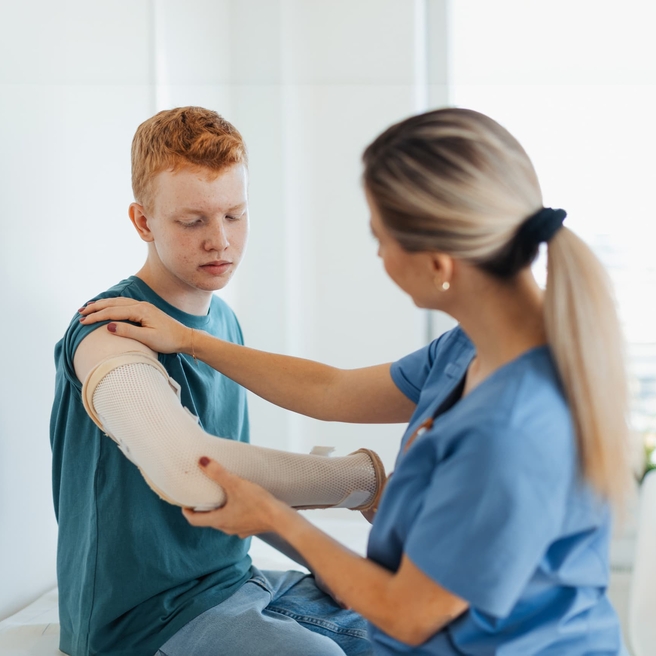
No matter which surgical procedure your child received, they will spend at least 1-2 weeks after surgery in a cast or splint. In many cases, patients can be transitioned to a hinged elbow brace at their first post-operative appointment.
If your child receives the OATS procedure, they will be placed in a full arm cast or splint for a few weeks to heal. Once the cast is removed, customized physical therapy will help your child regain their strength, full function and range of motion to resume sports.
Long-term outlook for youth with OCD of the elbow
The long-term outlook for children and teens treated for osteochondritis dissecans of the elbow is generally positive. Most patients can return to their pre-injury level of sport after treatment.
Factors that may affect outcomes include:
- Age of diagnosis and treatment: Younger patients with open growth plates typically have a better long-term prognosis.
- Severity of the lesion: Smaller and stable lesions tend to have better outcomes.
- Loose or detached bone or cartilage that is not addressed with surgery can negatively affect outcomes.
- Treatment decisions: Depending on the specific injury, osteochondral autograft transplantation or osteochondral allograft transplantation may offer better outcomes than arthroscopic surgical treatment.
- Following strict rehabilitation guidelines can maximize recovery and function after treatment. In addition to post-op timing, recovery is advanced based on strength and functional milestones.
- Participating in high-impact activities: Athletes may need to change activities or switch sports to protect the affected elbow.
If OCD of the elbow is left untreated, there can be long-term consequences including arthritis, pain and limited motion in the affected limb.
Guidance for parents and athletes to decrease OCD of the elbow
Overuse injuries like OCD of the elbow occur most often due to vigorous training, repetitive movements and early sport specialization. To help prevent elbow overuse injuries in general, orthopedic experts recommend athletes:
- Learn and complete proper warm-up and stretching exercises – based on the specific sport – before practice or competition
- Maintain conditioning regimes to keep or improve strength, flexibility, tolerance and overall fitness
- Vary the intensity of training to include warm-ups, moderate activities and vigorous-intensity activities and cool-downs
- Make time for free play and sports or activities that can be enjoyed throughout life such as cycling, hiking, tennis or golf
- Take weekly breaks (for example, Sundays off) and take breaks between sports seasons
- For baseball and softball players: Follow pitch-limit guidelines based on your child’s age (for example, 75 pitches per day for 9- and 10-year-olds; 85 pitches per day for 11- and 12-year-olds)
- Take your child to a trained pediatric orthopedic physician if they have any signs or symptoms of elbow pain. Diagnosing OCD of the elbow early may prevent the need for surgical intervention.

Optimizing your offseason
A guide for adolescent and teen baseball players.
Resources to help
Sports Medicine and Performance Center Resources
We have created resources—including patient and family educational materials, videos, and more—to help you find answers to your questions and feel confident about the care you are providing your child.
Meet your team
Our team includes board-certified orthopedic surgeons and sports medicine physicians, physical therapists, athletic trainers and nutritionists, as well as advanced practice nurses and physician assistants. We offer complete and individualized care for your young athlete.
Reviewed by Joseph L. Yellin, MD, Michael Beasley, MD, FAAP, CAQSM, FAMSSM, Apurva S. Shah, MD, MBA
Reviewed on 08/26/2025