Goldenhar Syndrome: Shaikha’s Story
Goldenhar Syndrome: Shaikha’s Story
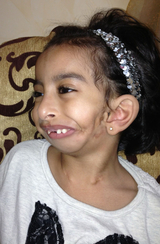
In the seventeen years of Shaikha’s life, she has spent an exceptional amount of time undergoing medical procedures. “By the age of 11, I already had 19 surgeries,” she explains. “I've had 25 surgeries in total.”
The surgeries started just months after she was born with Goldenhar syndrome, a rare condition that causes underdevelopment on one side of the body, mostly on the face. “Goldenhar includes a spectrum,” says Jesse Taylor, MD, Chief of the Division of Plastic, Reconstructive and Oral Surgery and Co-Director of the Craniofacial Program and the Cleft Lip and Palate Program at Children's Hospital of Philadelphia (CHOP). “It ranges from mild forms of facial asymmetry all the way to a very severe form of asymmetry that can include the eye, jaw, ear, collarbone, and sometimes some spinal differences or kidney differences.” Shaikha’s case fell on the severe side of the spectrum.
After being born in the United Arab Emirates, Shaikha and her parents traveled to the United Kingdom for care and treatment. That’s where she began her journey of surgeries.
“She had a cleft lip on the left side, and she was missing the left side of her jaw,” her mother, Alia, says. “She had many complications in her breathing at an early age.” Shaikha’s mouth would often stay open, and her tongue would fall back, obstructing her airway. At times she would inhale liquid into her lungs. The condition also affected her kidneys. “She couldn’t swallow food until she was almost 9,” says Alia. “She had so many things. They were fixing them step by step.”
In 2013, Shaikha’s care was transferred to doctors in South Korea, and she had several more surgeries there. She subsequently went to Washington, DC, but the doctor who began treating her retired after a few months. “He advised us to go to CHOP,” says Alia.
‘There’s an end to all this’
At CHOP, Shaikha was primarily seen by Dr. Taylor and Hyun-Duck Nah, DMD, MSD, PhD, the Director of Craniofacial Orthodontics. “I love Dr. Nah. I love Dr. Taylor,” Shaikha enthuses. “Every time I go to them, even if I was, let’s say, in pain, I would come back with a huge smile — knowing there’s an end to all this.”
Alia: “They always gave her hope.”
Shaikha’s surgeries at CHOP began with tooth extractions. Next was jaw distraction surgery, which involves the insertion of devices into the jaw to lengthen the jawbone and further open the airway.
“It was pretty tough, but I got through it,” Shaikha reports of the jaw distraction process.
Alia: “After the distraction surgery, we really saw the big difference. It made her breathe easier.”
In March 2024, she underwent what she describes as “the huge surgery” on her jaw. “I was pretty nervous about it,” she admits.
Orthodontics plus plastic surgery
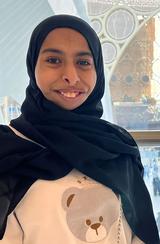
“Doing jaw surgery is always very coordinated — I call it a coordinated dance between orthodontics and the surgeon,” Dr. Taylor says. “Both parties are equally important. Orthodontic care before jaw surgery takes close to a year. What we're doing is getting the teeth to fit together when we do the surgery. To put it a different way, orthodontists move teeth within bone, surgeons move bone. Dr. Nah and I talk to each other on almost a daily basis. I know what she's thinking. She knows what I'm thinking. And that's how it's got to be to get a good result.”
Shaikha’s judgment on the jaw surgery? “I had a hard time at first, especially with eating. But I am so satisfied with the results.”
Saying that she merely had “a hard time” after such a major complex surgery is clearly an understatement — but this is typical of Shaikha’s attitude, according to her mother: “She’s always choosing the positive side of the story. She’s not mentioning the pain or how many stitches she had. She is grateful for everything. She’s always positive. She has strong energy and confidence.”
Dr. Taylor agrees. “I'm really excited that I've gotten to know Shaikha over the years. She's an incredibly intelligent and engaging young woman. The fact that she and her family were willing to make the investment to come to Philadelphia for a prolonged period of time to go through orthodontics, followed by jaw surgery, followed by another surgery to fix the asymmetry of her nose and cheek, really meant a lot to me because I knew I had a picture in my mind's eye of what we could do for Shaikha.”
Shaikha and her family have returned to the United Arab Emirates. While her favorite hobby is writing — “Poems, diaries, stories, I write everything” — she is thinking of making nursing a career. “As a kid, I thought I would never go into anything related to the medical field. But now I feel like this is fascinating. I mean, I’ve been through a lot, and I would understand how anyone would feel.”
In the meantime, she’s happy to share her story. “I want to let anyone with Goldenhar syndrome know that everything is going to get better if you wait and stay optimistic,” she says. “This is a long journey, but it’s going to turn out great if you trust the process.”